
Transformer oils have typically been “set it and forget it” for many companies in the past. As we transition into a more efficient and greener world, we focus on every detail relating to energy efficiency, reliability and asset lifetime extension.
Transformers are critical assets used in the Power Generation, Transmission and Distribution industry. These assets are critical to our economies ensuring that our homes and industries are provided continuous, uninterrupted and reliable power. Many of our islands see tremendous extreme weather conditions in particular during hurricane season. Our transformers must remain reliable even through extreme weather events.
Interestingly, many users are not fully aware of the functions of transformer oils.
The primary functions of the transformer oil are to insulate and cool a transformer.
It is important to obtain transformer oils that exhibit high dielectric strength, good heat transfer properties and robust chemical properties that all support reliability and efficiency of transformers. These oils must meet and conform to relevant IEEE and ASTM standards.
Transformer oils are typically mineral oil based, both paraffinic or naphthenic that conform to the ASTM D3487 standard. However, the use of ester-based transformer oils is becoming popular in several new installations regionally.
Companies have been testing transformer oils for decades. Many problems determined by oil testing have been sacrificially managed with quick fixes and less focus on proactive or long-term solutions. Quick fixes have been very supportive in attaining immediate acceptable results, most commonly, changing the oil. However, problems reoccur soon after. Many of these include moisture, dissolved gases and high acidity generated from transformer operations and load conditions. These are very detrimental to a transformer’s life and can even lead to catastrophic failure if left unresolved.
The proactive approach holistically reviews the condition of the oil, the condition of the transformer and its operation. Our primary focus is to protect the insulation from oil oxidation, heat, moisture and acid.
The simple explanation of oil oxidation is the breakdown of the transformer oil from heat, moisture and oxygen from its operations that include normal continuous operation, peak loads and even over loading. Transformers generate heat. The transformer oil transfers heat away from the transformer core naturally or via heat exchanges (typically fins) that allow for heat to dissipate from the transformer. Moisture increase is quite common in many transformers over time. Moisture comes from many sources depending on the type of transformer. These sources include damaged seals, saturated desiccant, oxidation by-products and even from the paper insulation. These are commonly known as pro-oxidants.
Conducting oil analysis and monitoring transformer oil analysis data is critical to ensuring that values remain within its limits. If these values change rapidly or exceed respective limits, proactive intervention is required and must be given high priority.
Moisture Content in Transformers
Increasing moisture is a common problem seen in oil analysis reports. Moisture increases safety risks associated with the loss of the dielectric strength of the transformer oil, increases oil oxidation and accelerates aging of the cellulose insulation in the transformer. Moisture must be kept within its limits.
Interested in learning more? Sign up now!
Acid Content in Transformer Oils
As oil ages, it degrades through oxidation from the pro-oxidants discussed above. Acid is a by-product of this aging process. Acids degrade the insulation and can eventually lead to corrosion of the internal core of the transformer accelerated with the presence of high moisture. Transformer life is affected unless proactive mitigation steps are taken.
Moisture and Acid Reduction in Transformers - A Proactive Approach
A simple and proactive approach to reducing high moisture and acid levels in transformers is prescribed below.
Step 1 - Set Targets
Set targets – our first step is to identify and set targets of the relevant parameters. In this case we will specifically review moisture and acid results.
- Moisture – Some transformer OEMs provide very specific targets. Typically, moisture should be below 20 ppm.
- Acidity – some transformer OEMs provide very specific targets. However, a general target is 0.01 mg/OH or lower.
Step 2 - Maintain Targets
Maintain Targets – Oil analysis is required to know the results of transformer oils. Normally, annual oil analysis is conducted. However, if high values are obtained, companies tend to conduct oil analysis more frequently. Depending how high results are, oil analysis can be quarterly or on in severe cases, monthly. If moisture and acid results are high, it is important that these are reduced as soon as possible. High values elevate the criticality and increases risk. Services to reduce moisture and acid are available from CASL. This process is explained below.
Step 3 - Measure
Measure (KPIs) – the last step in the proactive approach is to measure. Oil analysis is typically conducted immediately after oil processing to confirm the quality of the oil. The sample must be taken from the transformer. Then another sample is taken 6 months later and analyzed to determine if any there are changes. If results change, they must be investigated. Corrective actions must be taken to avoid any further increase.
Transformer Oil Reclamation by CASL
The combination of moisture and acid reduction is a complicated process. Competency is a major factor in executing these services. Typical contractors are ISO 9001 certified supported by oil testing from ISO 17025 accredited laboratory. This formalizes that all personnel are experienced, trained and competent. Transformers are high risk assets that must be supported by high quality processes and high competency. All laboratory consumables used for oil analysis must be traceable and tests must conform to the relevant ASTM standards. Quality assurance and quality control documentation must be readily available for review any time required.
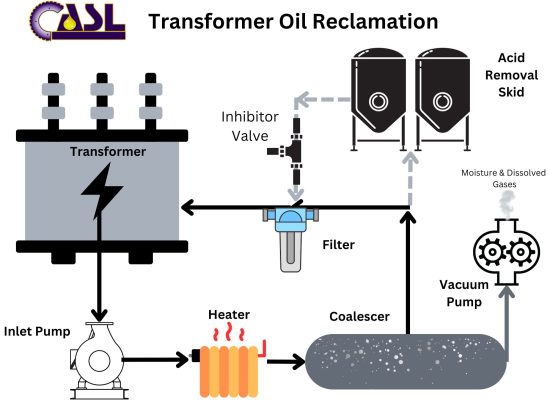
The actual reclamation process can be simplified as shown in photo 1. There are many other benefits achieved within this simplified process. With the used of PLC, flowmeters, pressure transmitters, and online sensors, the process can be optimized. The following outlines additional support services:
- Removal of oxidation by-products
- Removal of sludge
- Removal of dissolved gasses
- Improvement of Power Factor
- Improvement of Dielectric Strength
- Reduction of Furans
- Addition of Inhibitor
Photo 1- Schematic of Transformer Oil Reclamation
A simple and effective way to monitor treatment progress is a visual of the transformer oil. Refer to the photo 2. The aged oil is dark. As the treatment progresses, the color of the transformer oil become lighter and golden yellow in color. However, oil analysis must still be conducted to determine the final properties of the oil.
Photo 2 - Transformer Oil Color Change during Transformer Reclamation

Moisture Reduction in Transformers
Moisture reduction in transformer oil is typically performed with a vacuum dehydrator. Not all vacuum dehydrators are made equally. Clients must request equipment specifications to review equipment performance. Contractors must also guarantee in writing that the moisture can be reduced to meet IEEE standards.
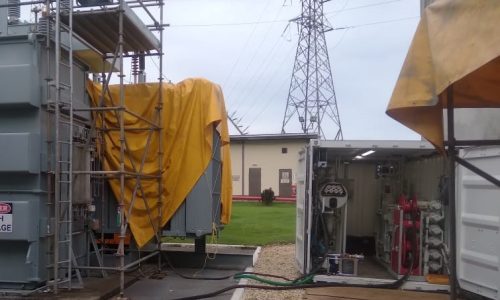
Oil is drawn into the dehydrator via a vacuum pump. It passes through a heater that heats the oil to approximately 160F. The oil flows into a coalescing chamber. In the coalescing chamber, the oil breaks into tiny droplets, which allows for moisture to efficiently separate from oil. The separation efficiency is critical to ensure that majority of the moisture is removed in one pass. This efficiency is related to the vacuum and temperature of the vacuum dehydrator. The oil is then passed through a filter and returned to the transformer. The process also effectively removes dissolved gases.
The process outlined is simple but a good vacuum dehydrator is a very complicated machine. It normally is designed with safety as the key operational priority. Transformers are considered mission critical. Oils that do not meet the required specifications after processing must be immediately isolated. Instrumentation is also included to manage flow, temperature, pressure, and moisture.
A photo of one of CASL’s Oil Processing Vacuum Dehydrators is provided below in Photo 3.
Photo 3 - CASL's Transformer Oil Processing Vacuum Dehydrator
Acid Reduction in Electrical Transformers
High acidity in a transformer must be taken seriously. Acids develop from the oil’s degradation process, known as oxidation. It is very common within aging transformers. The presence of acid is commonly associated with darkening of transformer oils and development of sludge within the reservoir, insulation and cooling fins. Using thermography or an infrared thermometer, increasing temperature or variations in temperatures can be detected. Increasing temperature are typically associated with oxidation and sludge. Acid is also destructive to the paper insulation and copper windings.
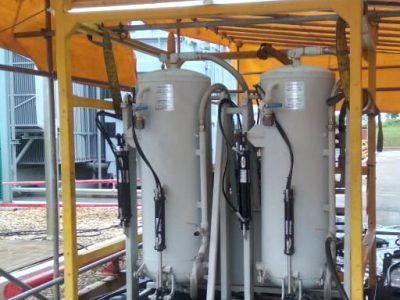
Acid reduction is completed using an engineered earth media that is designed to adsorb acid molecules. These systems can be regenerative where two banks for media is used for the process. Spent media in one bank is regenerated while the oil is processed using another bank. Some systems are not regenerative. The choice of system is dependent on the type, size, and concentration of acid. CASL can support with acid reduction and removal to meet IEEE standards. Refer to photo 4.
Photo 4 - CASL Transformer Oil Processing Unit for Acid Reduction
Transformer Oil Services in The Caribbean
CASL provides transformer oil processing and reclamation services throughout the Caribbean. CASL’s safety is its number one priority when supporting critical transformer assets. Its competent team and several hundred references throughout the region makes CASL the preferred choice in transformer oil reclamation.
CASL offers complementary support services. These include the addition of oxidation inhibitor, ultrasound services for particle discharge, desiccant breathers, nitrogen filling, vacuuming and online dehydration systems and sensors.
Interested in learning more? Sign up now!